About Fitted Dinghies

This article is licensed under the GNU Free Documentation License. It uses material from the Wikipedia article "Bermuda Fitted Dinghy"

The 'Bermuda Fitted Dinghy' is a type of racing-dedicated sail boat used for competitions between the yacht clubs of Bermuda. Although the class has only existed for about 130 years, the boats are a continuance of a tradition of boat and ship design in Bermuda that stretches back to the earliest decades of the 17th Century.

Advent of Sail Racing in Bermuda

A 19th Century Bermudian working boat.

With the build up of the Royal Naval Dockyard on Ireland Island, at the West End, and of the Army garrison, at first in the East End, at St. George's, though the military headquarters eventually moved to Prospect Camp at the centre of the colony, the idle navy and army officers, most ex-Public School boys, introduced a number of team sports to the colony. The best known of these were football, cricket, and rugby. At English schools and colleges, however, many had also competed in rowing, and an attempt was made to introduce this sport to Bermuda, also. The rough, wind-driven Atlantic proved unsuitable, however, and the officers soon took to employing the local work boats for sail racing. These large sloops, with their crews, were hired for weekends, and sloop racing became very popular in Bermuda throughout the century. In time, sloops were designed and built specifically for racing, though they still relied on large, hired crews. The military officers were the driving force behind the creation of the Royal Bermuda Yacht Club (RBYC), in 1844, and, as with cricket, the sport developed an East End versus West End dynamic, resulting from the polar locations of the two headquarters.

Introduction of Dinghy Racing

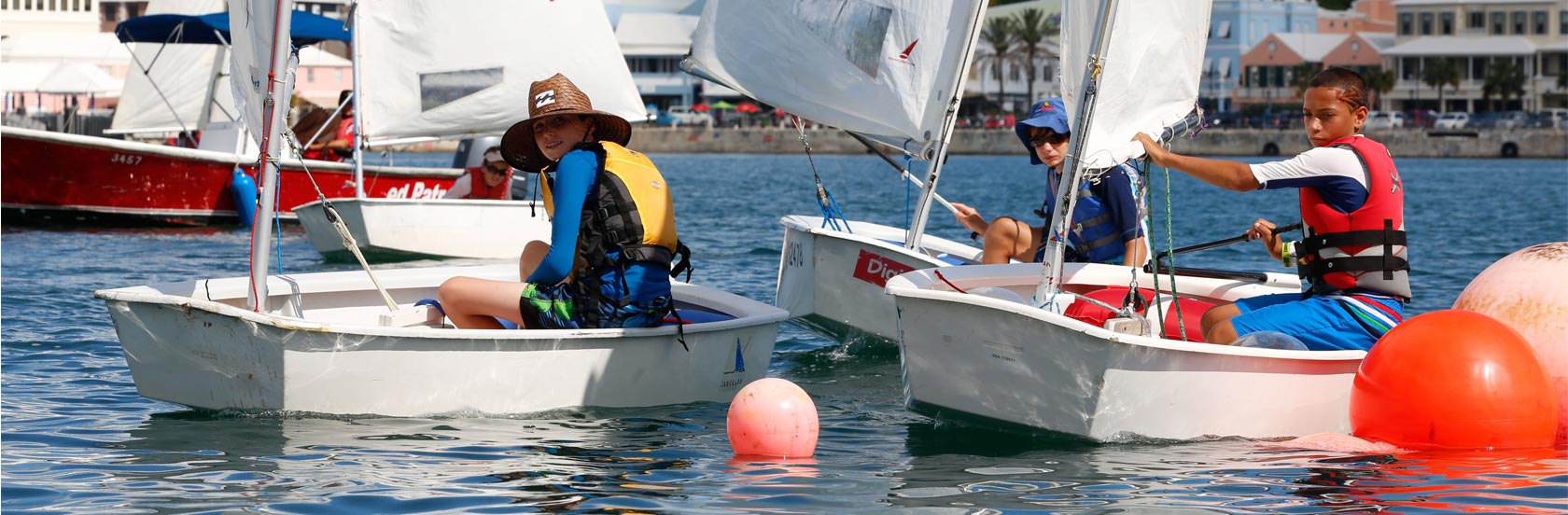
By 1880, however, there was great concern that the need for professional crews in sloop racing was making the sport too expensive, and that its development was stagnating, as a direct result. Dinghy racing was developed as a cheaper alternative. When the Bermuda Dinghy first appeared is uncertain, but the design is scaled down from the earlier sloops, rather than appearing to be an evolution of the dinghies and small boats previously used for more mundane purposes. The first race was held on the 26 August, 1880. A number of types of smaller boats were raced in different classes. The dinghies were restricted to amateur crews. In 1882, the Hamilton Amateur Dinghy Association was formed, holding its first races on the 28th July. This association ultimately becams the Royal Hamilton Amateur Dinghy Club. In 1883, HRH Princess Louise, daughter of Queen Victoria, visited Bermuda, and she donated a trophy which was awarded to the winner of a dinghy race held on the 8 March, which was restricted to boats both owned and steered by club members. A purse race was held after, which was open to all amateurs. Dinghies for this race were restricted to hulls of 12 feet of keel, and 14 feet, 1 inch overall.

The Bermuda Fitted Dinghy

These dimensions have remained consistent since. Despite the small hulls, however, the dinghy's carried substantial rigging. Although square topsails were reportedly in use in the 1880s, the form used today soon developed, basically scaled down from the larger sloops. One early example, the Reckless, was fitted with a 28 foot mast, 28 foot boom, 14 foot bowsprit, and 20 foot spinnaker boom. She carried 70 square yards of canvas going upwind, while the spinnaker increased this to 92 square yards running downwind. Original Bermuda Dinghies were roundbottomed and fitted with long, shallow keels so they would be easy to beach or could run over reefs without damage. During the first recorded race, held in St. George's Harbour in 1853, the existing boats were fitted with deep keel extensions fastened in place temporarily to give them the bite to sail better to windward. These metal keels -or fans,as they are called- differentiated these racing boats from the "unfitted" working dinghies and gave the class its name.

Racing

The dinghy racing, today, is an inter-club activity, fought between the Royal Bermuda Yacht Club (RBYC), the Royal Hamilton Amateur Dinghy Club (RHADC), the St. George's Dinghy and Sports Club and Sandy's Boat Club. Whereas most of the professional crews of the earlier sloop racing, which has since died-out, were probably Black, the restriction of dinghy racing to these clubs, with their membership historically restricted to whites, means that Bermuda Fitted Dinghy racing has maintained an exclusive, all-White reputation in Bermuda. Although it is true that mounting a dinghy campaign requires significant financial and personnel resource, new entries are welcomed regardless of race, and many of Bermuda's best-known fitted sailors are Black, including Stevie Dickinson and Glenn Astwood.

The racing is carried out on set dates in a variety of locations including Hamilton or St. George's Harbours, Granaway Deep, and Mangrove Bay. The dinghies sail windward leeward courses and the number of legs is decided based on the conditions at race time. Boats always finish to windward. The boats, despite their small sizes, are each normally crewed by six people, necessary to handle the large areas of sail, and also to continually bail the dinghies, which have very low freeboard, and which are often capsized by powerful gusts. A unique rule to racing states that the number of crew to finish a race can be less than the number that started. This can encourage boats to throw crew over board during a race to help lighten the boat and increase performance.

Boats

As of 2006 4 boats are being raced regularly during the Bermuda Fitted Dinghy season. Although there have been rumours of other boats returning to the race course

Contest III -Royal Bermuda Yacht Club

Skipper: Somers Kempe

Challenger II -Sandy's Boat Club

Skipper: Martin Siese

Victory IV -St. George's Dinghy and Sports Club

Skipper: Michael Oatley

Elizabeth II -Royal Hamilton Amateur Dinghy Club

Skipper: John Nichol

Boats Rumoured to Return in the Near Future

Port Royal II -Knight White Dinghy Association

Bloodhound -Bermuda Maritime Museum

Skipper: Jordy Walker

Echo -Sandy's Dinghy Association

Coronation Cup

This trophy is awarded to the overall winner of every season. The results from the last 7 seasons are...

2008- Contest III

2007- Contest III

2006- Contest III

2005- Challenger II

2004- Contest III

2003- Contest III

2002- Contest III

Sources

  • Sailing in Bermuda: Sail Racing in the Nineteenth Century, by J.C. Arnell, 1982. Published by the Royal Hamilton Amateur Dinghy Club. Printed by the University of Toronto Press.